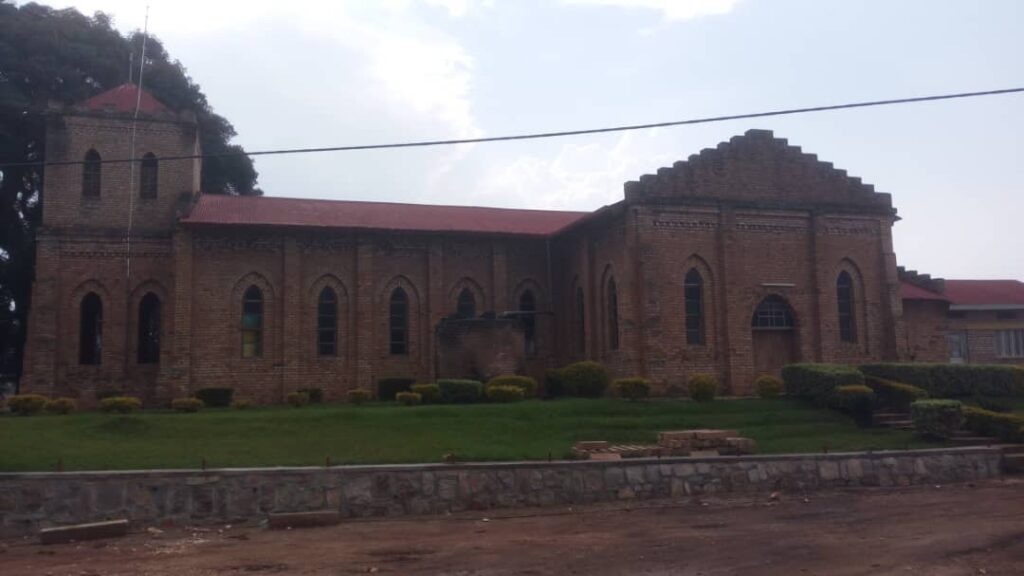
HISTORICAL BACKGROUND AND DEVELOPMENT OF THE ANGLICAN CHURCH OF RWANDA (EAR), KIGEME DIOCESE
Establishment and Legal Foundation of Kigeme Diocese The Anglican Church of Rwanda (EAR), Kigeme Diocese, was officially established on 12 July 1992. At the time of its foundation, it was known as EER (Église Épiscopale au Rwanda) and originated from the former Diocese of Butare. The creation of Kigeme Diocese was a response to the growing pastoral, evangelical, and administrative needs of the Anglican faithful in the southern regions of Rwanda, particularly in the mountainous areas that required closer spiritual care and effective church governance.
The decision to establish the Diocese of Kigeme was formally approved by the Synod of the EER Diocese of Butare on 10 November 1991. This approval marked a significant step toward decentralizing church administration and strengthening evangelization efforts in rural and semi-rural communities. Subsequently, the Diocese of Kigeme was granted legal recognition by the Government of Rwanda through Legal Authorization No. 318/05 of 10 November 1992, which officially confirmed its status as a recognized religious institution operating within the country.
From its inception, the Diocese of Kigeme committed itself to fulfilling the mission of the Anglican Church: proclaiming the Gospel of Jesus Christ, nurturing Christian faith, promoting social transformation, and contributing to national development through spiritual, educational, and humanitarian initiatives.
Initial Administrative Structure and Early Growth At the beginning of its ministry, Kigeme Diocese was administratively organized into four (4) archdeaconries, comprising a total of thirteen (13) parishes. This structure was designed to ensure effective pastoral supervision and coordination across the vast and geographically challenging terrain of the Diocese.
The Bunyambiriri Archdeaconry was the largest at the time and included the parishes of Nkomero (established in 1960), Karambo (1965), Bugarama (1974), Kibibi (1992), and Tubuye (1992). These parishes played a pioneering role in evangelization and community development, serving as centers for Christian teaching, education, and social support.
The Buyenzi–Nyaruguru Archdeaconry consisted of the parishes of Mubazi and Cyivugiza, both of which were instrumental in spreading the Anglican faith in remote communities and fostering unity among believers.
The Kigeme Archdeaconry included the parishes of Kigeme and Uwinkomo, which later became key hubs for diocesan administration, theological formation, and coordinated pastoral activities.
The Mugombwa Archdeaconry comprised the parishes of Mugombwa, Karambi, Kirambi, and Mbazi. This archdeaconry was particularly important in strengthening evangelism in border and rural areas, emphasizing both spiritual growth and social outreach.
Through this early structure, Kigeme Diocese laid a strong foundation for growth, unity, and sustainable ministry.
Expansion and Current Status of the Diocese (Up to 2022) By the year 2022, the Anglican Church of Rwanda, Kigeme Diocese, had experienced remarkable growth in both size and scope. The diocese expanded from its original 13 parishes to seventy (70) parishes, organized into six (6) archdeaconries. This growth reflects the success of evangelization efforts, church planting initiatives, and the commitment of clergy and lay leaders.
In addition to the parish structure, the diocese established fourteen (14) evangelistic zones, which support mission work, discipleship, and outreach programs at the grassroots level. These zones facilitate closer interaction between church leadership and local Christian communities.
The diocese oversees three hundred and thirty (330) churches and one thousand three hundred and eighty-one (1,381) basic Christian communities, commonly known as small Christian communities. These communities play a vital role in fostering fellowship, prayer, Bible study, and mutual support among believers.
As of 2022, the total number of Christians in the Diocese of Kigeme was estimated at 81,133 believers. This growth demonstrates the diocese’s strong spiritual vitality and its increasing influence in promoting Christian values and social cohesion within Rwandan society.
- Symbolism and Theological Meaning of the Diocesan Logo From its foundation, the Diocese of Kigeme adopted a distinctive logo composed of five (5) symbols, each carrying deep theological and pastoral significance.
The Open Door The open door symbolizes an open gate leading to the mountainous landscape of the diocese. It reflects the Church’s openness to all people and its mission to carry the Good News of salvation into remote and challenging regions. The presence of a dove above the hills represents the Holy Spirit, who empowers and guides the Church in its evangelistic mission.
The Shepherd’s Mitre The mitre represents the episcopal authority and spiritual leadership of the bishop. It reflects the Anglican tradition and emphasizes the role of the bishop as a shepherd entrusted with guiding God’s people in faith and truth.
The Shepherd’s Staff Across the Doorway The staff crossing the doorway symbolizes pastoral care, protection, and welcome. It expresses the Church’s readiness to receive all who seek spiritual guidance, comfort, and reconciliation.
Wheat on the Hills Wheat is one of the oldest crops grown in the mountainous regions of Kigeme. It symbolizes life, sustenance, and productivity, representing both agricultural abundance and spiritual nourishment. It also reflects the socio-economic context of the diocese and the Church’s commitment to holistic development.
The Power of the Shepherd’s Staff – SOLA DEI GRATIA The motto SOLA DEI GRATIA (“God’s grace alone is sufficient”), drawn from 2 Corinthians 12:9, affirms the theological foundation of the diocese. It proclaims reliance on God’s grace as the source of strength and success in ministry.
- Episcopal Leadership and Spiritual Direction Since its establishment, the Diocese of Kigeme has been guided by three bishops, each contributing uniquely to its spiritual and institutional development.
Bishop Norman KAYUMBA (1992–1999) was the first bishop of the diocese. During his leadership, he laid the foundational structures of administration, pastoral ministry, and diocesan identity. He adopted SOLA DEI GRATIA as the guiding principle of his episcopate. For six years, he was assisted by Bishop Alexis BIRINDABAGABO.
Bishop MVUNABANDI Augustin (2000–2017) emphasized spiritual growth and unity, grounding his ministry in John 15:4–5: “Abide in me, and I in you.” His leadership strengthened discipleship, clergy formation, and community engagement.
Bishop MUSABYIMANA Assiel (2018–present) continues to lead the diocese with faith and vision, guided by Matthew 19:26: “With God all things are possible.” His episcopate focuses on mission, development, and hope for the future.
- VISION
The vision of EAR Kigeme Diocese is “to be a Church that glorifies God and blesses the nations” (1 Peter 4.11).
- MISSION
The principal mission of Kigeme Diocese is to spread the Good news of Jesus Christ to all the people and to contribute to the well being of Rwanda People regarding the socio-economic, cultural, intellectual and health development and the protection of human right.
- OBJETIVE
To enable Kigeme Diocese find a revelation which enables the efficience of available means in order to have a strong organization for better serving all the population in general and particularly all its members who are in its catchment area.
- CORE VALUES
The core values of Kigeme Diocese are:
- Christ centred
- Bible Based
- Stewardship
- Integrity
- Excellence
- ACHIEVEMENTS SINCE 1992
All the activities of EAR Kigeme Diocese are centered on three main pillar which evolved together with the early Anglican Missionary work Evangelism, Healthcare and Education.
- EVANGELISM
As a result of evangelism, Kigeme Diocese count more than 80,000 active members in 6 Archdeaconries, 12 Districts, 64 parishes, 9 sub-parishes, 260 chapels, 1,444 grassroot churches.
There has been set six steps to test if a born again christian has become a true disciple of Jesus Christ.
As a challenge, 128 over 260 chapels are still suspended for not complying with government requirements, and only 50 over 72 pastors do not comply with education requirement with a must to train them before 2023, otherwise they will be denied to continue the service.
- HEALTH CARE:
There is Kigeme Hospital which started together with the missionary work in 1930s and built in 1938. Currently, it serves above 200, 000 people from 11 Health Centers plus 2 Dispensaries. There is also a Health Center managed in partnership with the Government, and a health Post.
- EDUCATION
EAR, is counting more than 80 nursery schools, 46 Primary Schools and three primary schools without a complete cycle, 18 Secondary schools among which 2 boarding (G.S. Kigeme A and E.S Mbogo), 3 Technical and Vocational Education Training Schools.
Primary and Secondary Schools are managed in collaboration with the Government of Rwanda.
- DEVELOPMENT PROJECTS AND PROGRAMS
- REFUGEES PROTECTION
In 2012, Kigeme Diocese lent a piece of land of more than 10ha to the Ministry of Emergency Management and Refugee Affairs (MINEMA) for accommodating the Refugees from the Democratic Republic of Congo.
- FOOD SECURITY PROGRAM
Livestock to people (Goats, Pigs and Cows), Capacity building of assistants veterinarians of intervention, Milk Collection Center to be developed in a diary.
- SAVINGS AND CREDIT SCHEME
By 2017, they were more than 1,300 saving groups operating with more than 19,500 members who secured RWF 217,500,000 of savings, among them FRW 109,500,000 of loans were distributed to 10,500 members.
- JUSTICE, PEACE, RECONCILIATION AND CITIZEN PARTICIPATION PROMOTION
For the sensitization of the population in its intervention area for their participation to the local government performance contracts elaboration and implementation.